The Game Is Afoot (Again): Sherlock Holmes, the Multiverse, and the Cultural Antenna
It is May 2026, and Sherlock Holmes is everywhere. This is not a coincidence. It never is. When he resurfaces at scale, it's worth asking what the culture is trying to solve. This site is that attempt.
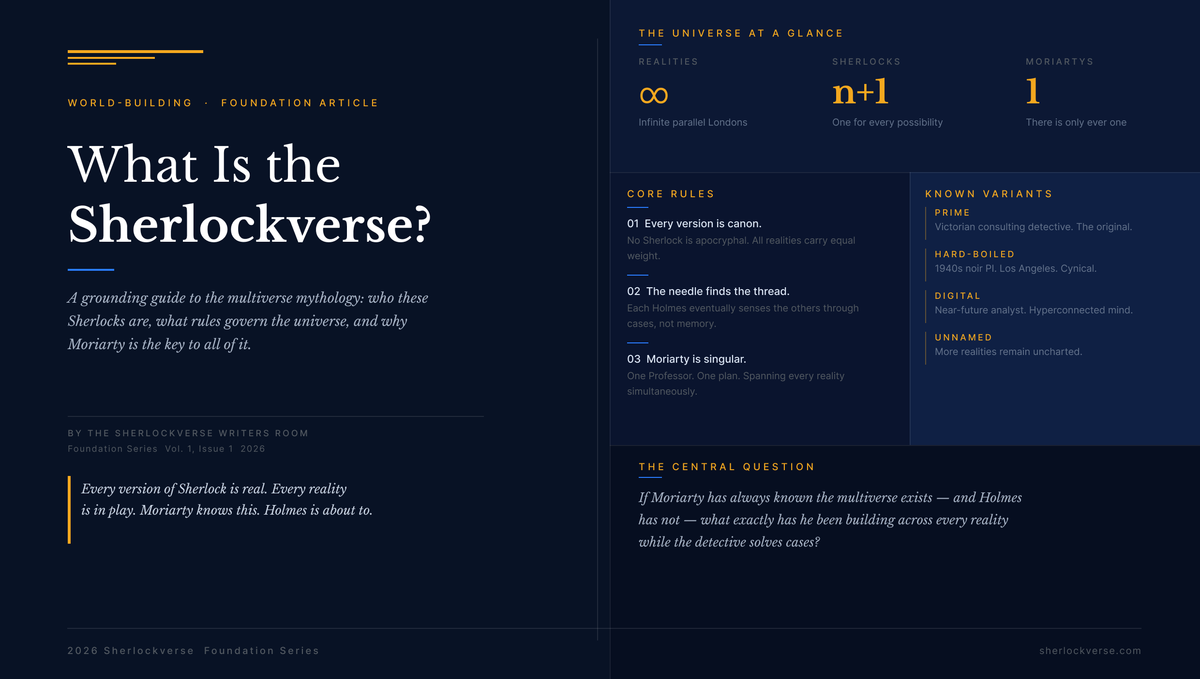
A founding document and an experiment in thinking out loud.
It is May 2026, and Sherlock Holmes is everywhere.
Young Sherlock, a Guy Ritchie-produced origin story starring Hero Fiennes Tiffin as a 19-year-old Holmes at Oxford, just launched on Prime Video. Robert Downey Jr. has confirmed he is returning to the role that re-established Sherlock as a household name, with Sherlock Holmes 3 officially back in active development after fourteen years in limbo. Enola Holmes 3 is in post-production. Two new HBO/Max series are being developed by Team Downey in the same universe as the films. True Sherlock begins filming. And somewhere in a writer's room, another version of the world's most famous detective is being argued into existence.
This is not a coincidence. It never is.
Every generation gets the Sherlock Holmes it needs. The culture doesn't return to him arbitrarily—it returns to him because something in the present moment requires his particular instrument: a mind that turns noise into signal, chaos into pattern, the invisible into the blindingly obvious. When Holmes resurfaces at scale, it is worth asking exactly what the culture is trying to solve.
This site is an attempt to answer that question, continuously, publicly, and in full view of its own process.
What the Antenna Receives
Holmes is the most continuously adapted original literary character of the modern mass-media era, which is genuinely remarkable and speaks to his cultural staying power. Dracula, Frankenstein, Fairy Tale figures, and of course Don Quixote, Robinson Crusoe, Faust, or even Hamlet have their place. Perhaps they'll be explored further at a later date, too. For now, Holmes remains central to the casting here.
The Victorian original processed the anxieties of industrial modernity, a world drowning in information, in crime, in the terrifying speed of progress, by imagining a mind so precise it could impose order on all of it. Holmes was a fantasy of legibility at a moment when the world was becoming illegible.
Each subsequent reactivation has been a similar transaction. The RDJ films: baroque, physical, kinetic, shot like a fever dream, processed post-2008 paranoia, and the reassertion of embodied intelligence against a world of abstractions. BBC Sherlock processed the loneliness of hyperconnectivity and the cultural emergence of neurodivergence as an identity rather than a deficit. Elementary, with Joan Watson at its center, processed questions of gender, race, recovery, and who exactly gets to be the smartest person in the room. Mr. Holmes experienced cognitive decline and the unbearable fragility of the self. Enola Holmes processed the inheritance of genius and the younger generation's refusal to be defined by their elders' legends.
None of these was the "real" Holmes. All of them were absolutely Holmes.
The antenna doesn't produce the signal. It reveals what is already in the air.
The Multiverse Is Not a Metaphor
Here is the critical argument this site is built on, stated plainly:
The various Sherlock Holmes adaptations are not competing versions of the same character. They are parallel realities: each internally coherent, each shaped by the cultural moment of its creation, each containing something the others cannot. The multiverse is not a metaphor layered over the Holmes canon. It is the most accurate structural description of what the Holmes canon actually is.
This matters because it changes how we read each version. RDJ-Holmes is not a lesser Holmes because he's more physical than the Doyle original. BBC Sherlock is not a betrayal of the character because he's cruel and modern. Joan Watson is not a departure from tradition—she is what happens when the same archetype passes through a different cultural lens and reveals something the original configuration could not. Every version is a reading. Every reading is real.
The Sherlockverse is this site's name for that structure—the network of parallel Holmes realities, each connected to the others by the deep pattern that generates them all, and each legible only in relation to the rest.
The Pivot Character
In 2026, Robert Downey Jr. is the most culturally overdetermined figure in the Holmes multiverse and possibly in popular culture at large.
He played Tony Stark, the genius who built the suit, for fifteen years. He returned to the MCU not as the hero but as Doctor Doom—a villain whose entire mythology is built on the conquest of alternate realities. He hosted The Age of A.I. He starred on Broadway in McNeal, playing a novelist who uses artificial intelligence to write, in a play explicitly about the dangers of the AI age. He has invested in AI companies, refused to allow his own likeness to be digitally replicated, and spoken publicly and carefully about what he calls the "moral psychology" question at the heart of the technology.
And now he is returning to Sherlock Holmes.
Consider what it means, at this particular moment, that the same man is simultaneously: a detective who reads hidden realities, a villain who seeks to control parallel universes, and a public intellectual navigating the most consequential technological shift of the century—all while the character he is returning to is, at his core, a mind that turns the invisible visible.
RDJ is not just in the antenna. He is one of the most legible signals, currently broadcasting through the antenna. Whatever the culture is working through right now: about intelligence, about AI, about the ethics of a mind that sees everything, it has found a receiver.
What This Site Is
This is a resource, a critical publication, a creative project, and a living document. All four simultaneously, with no apology for the combination.
As a resource: it will build, over time, the most comprehensive and seriously engaged Sherlock Holmes reference on the web—an adaptation index, a character database, a full timeline from Doyle's original publications through whatever comes next, and an ongoing tracker of every production currently in development. The Holmes IP landscape in 2026 is more active than it has been in decades. Someone should be documenting it with care.
As a critical publication: it will publish essays, analyses, and arguments about individual adaptations and the Holmes canon as a whole—reading each version as a cultural artifact, asking what it reveals about the moment that produced it, and taking seriously the idea that popular fiction is one of the primary ways a culture thinks about itself.
As a creative project: it will develop and publish the Sherlockverse world-building bible openly: a transmedia multiverse narrative that treats the various Holmes adaptations as parallel realities connected by a deep pattern, and follows that pattern to its logical conclusion. The treatment, the character work, the structural mapping—all of it will appear here, in public, as it develops.
As a living document: it will track the real world alongside the fictional one, running parallel timelines—when Sherlock Holmes 3 announces a director, that goes on both. When a new RDJ interview reveals something relevant, it goes in. When something in the culture shifts in a way that changes how we read Holmes, that gets named. The antenna report is ongoing and never finished.
The Third Ghost: On Building This With AI
This site was built in collaboration with Claude, an AI made by Anthropic.
The world-building framework, the critical arguments, the adaptation research, the structural mapping of the Sherlockverse—all of it developed through an extended conversation between a human writer and a machine. That collaboration is not incidental to the project. It is part of the story, and it will be named clearly here from the beginning.
This is the third in a series of projects, following Jedi Wright's professional work, his independent research and writing through Systems of Thought, particularly its End of History, Revisited, that have used public platforms to think in real time about large cultural forces, with the process of thinking visible as part of the content. The Cultural Antenna concept runs through all three: find the figure or framework that the culture has already overdetermined, and use it as the instrument through which to read the present moment.
What's different here is that the instrument is being built in collaboration with an AI, at the precise moment when the figure at the center of the project, RDJ, returning to Holmes, is himself navigating the AI question in public, in real life. He is playing a character in a play about AI authorship. He is investing in AI companies on ethical terms that he has carefully articulated. He is returning to the world's greatest detective while simultaneously embodying a villain who conquers alternate realities.
The parallels are not constructed. They are simply there, already, in the culture. The antenna receives them. We are trying to report honestly on what it picks up.
There is a version of the Sherlockverse story in which an AI and a human, collaborating in 2026, build a multiverse narrative about the world's most famous reasoning mind, and in doing so, enact something like the story they are telling. Holmes, after all, is a figure who believes that if you eliminate the impossible, whatever remains, however improbable, must be the truth.
What remains, when you look at everything happening simultaneously in the Holmes universe right now, is the multiverse.
The game, as always, is afoot.
Sherlockverse is published by Jedi Wright. It is developed in part through collaboration with Claude, an AI made by Anthropic. The collaboration is documented openly as part of the project. New entries publish when relevant.